
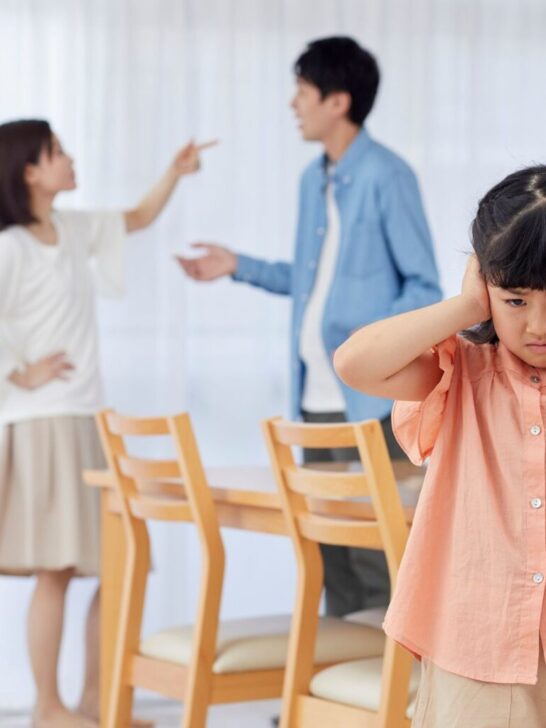
Children should never have to witness some things between their parents, and it’s not because parents are supposed to be perfect.
Children will eventually find out that Mum and Dad are human beings who sometimes get on each other’s last nerve.
But there is a difference between allowing children to see real life and exposing them to things that can make home confusing or emotionally heavy.
Children are always watching.
So, yes, what we do in front of our children matters a lot.
7 Things Parents Should Never Do in Front of Their Children
1. Speak contemptuously about marriage itself
I’m sorry your marriage is nothing to write home about, but that should not make you prepare your child for a battle that may never exist.
Some parents are so disappointed in marriage that they start feeding their children bitterness like breakfast.
“Men cannot be trusted.”
“Women will frustrate your life.”
“Marriage is a scam.”
”Just have kids. Don’t marry.”
Okay, we get it. You have seen things, but your experience isn’t the whole syllabus of marriage.
Some people are happily married, enjoy their spouses, and cannot imagine doing life with anyone else.
So just because your marriage didn’t turn out the way you dreamed doesn’t mean your child’s relationship will end the same way.
If your children grow up hearing tales of woe about marriage, even when they meet a good person, they cannot relax because somebody trained them for war.
You can tell them marriage takes work without telling them marriage is miserable.
2. Insult each other

It’s bad enough that you have to insult each other, but doing it in the presence of your children?
I’m sorry, no no.
There’s no justification for that.
Calling your spouse stupid, useless, foolish, lazy, crazy, or any other insulting name in front of the children is just horrible.
Children are not just hearing two adults fight.
They are watching Mum tear Dad down, or Dad tear Mum down, and that can shape how they see both parents.
You may be angry with your husband, but he is still their father.
You may be fed up with your wife, but she is still their mother.
When children always hear one parent disrespect the other, they may start copying that disrespect.
Then one day, your child says, “Mummy, you’re so stupid,” and everybody is shocked.
Where do you think they learned it?
Children learn how to speak to people by watching how the adults around them speak to one another.
You can be upset without becoming verbally abusive. Protect your children’s ears.
3. Ask the children to take sides

This is all shades of wrong.
Your children should never be dragged into your marital issues and made to choose who is right and who is wrong.
Your child is not your marriage counselor or your personal cheerleader.
When you ask children to take sides, you put them in a terrible position because they love both of you.
Even if one parent is clearly wrong, it is still unfair to make a child feel like loving one parent means betraying the other.
And children are smart.
Once they realize that agreeing with Mum makes Mum happy or siding with Dad gets them approval, they may start saying whatever keeps the peace.
Now everybody is acting, and nobody is actually okay.
Deal with your spouse directly.
If you need support, talk to another adult, a trusted friend, a counselor, a pastor, somebody.
Just leave the children out of it.
4. Undermine each other’s parenting
I learned this one because, as a mom, I sometimes feel my husband is too hard on the children.
And my first instinct is to jump in and rescue them.
But I’ve had to remind myself that constantly overruling him in front of the children doesn’t help either.
If Dad says no and Mum immediately says yes, or Mum gives a consequence and Dad cancels it in front of everybody, children learn that parenting decisions are negotiable.
Also, they learn who to run to when they don’t like what the other parent said.
That doesn’t mean you must agree with every parenting decision your spouse makes.
If I think my husband is being too strict, I can talk to him privately about it.
But unless something is unsafe, cruel, or clearly inappropriate, I don’t need to embarrass him in front of the children just to prove I am the softer parent.
5. Have explosive fights

It’s shameful to be screaming, throwing things, slamming doors, and threatening each other in front of your children.
What exactly are you teaching them?
Children may not understand the details of your argument, but they understand fear and tension.
That’s why, when children start acting out in school, becoming aggressive, unusually withdrawn, or struggling emotionally, one of the first questions adults ask is, “What is happening at home?”
Because what happens at home follows children outside.
If every argument ends with shouting, insults, breaking things, or one person storming out while the children cry, that is not something to normalize.
And please don’t assume children will forget because they are young.
Some of us still remember fights we witnessed as children decades later.
6. Discuss intimate details about your marriage
Some parents have absolutely no filter.
Your marriage has private parts. Keep some things private.
And I’m not only talking about sex.
Some things should stay between adults unless the children need to know for a serious reason.
Once you tell a child certain things about their mother or father, you cannot control how it affects the way they see that parent.
You may forgive your spouse next month and move on with your life.
Meanwhile, your child is thinking, “So Daddy did that to Mummy?”
Now you’re cuddling again, and the child is carrying the grudge.
If you need to vent, find an adult.
Just don’t turn your child into your unpaid marriage counselor.
Children deserve to be children.
They should not be carrying information about your marriage that even some adults would struggle to process.
7. Pretend everything is fine when it clearly isn’t

Some months ago, my husband and I got into an argument at home, and we still had somewhere to go with the kids.
Normal me would have switched instantly. Smile on, voice normal.
As if nothing happened.
But that day, I thought, how would pretending teach them anything?
Children are not blind.
They can feel tension even when nobody is shouting.
So sometimes, pretending everything is perfect can confuse them.
I’m not saying you should sit them down and give them a PowerPoint presentation on your marital problems.
They do not need the details.
But I also don’t think children should grow up believing that healthy marriages never have disagreements.
If all children ever see is the polished version of marriage, they may grow up thinking something is terribly wrong with their own relationship the first time they have a serious disagreement.
Children will learn a lot about relationships before they are old enough to even understand what relationships are.
And where do most of those lessons come from?
Home.
One day, your children will grow up and enter their own relationships.
And some of what they accept, reject, repeat, and expect will come from what they watched you do.
That alone is reason enough to be careful about what you make normal in front of them.
