
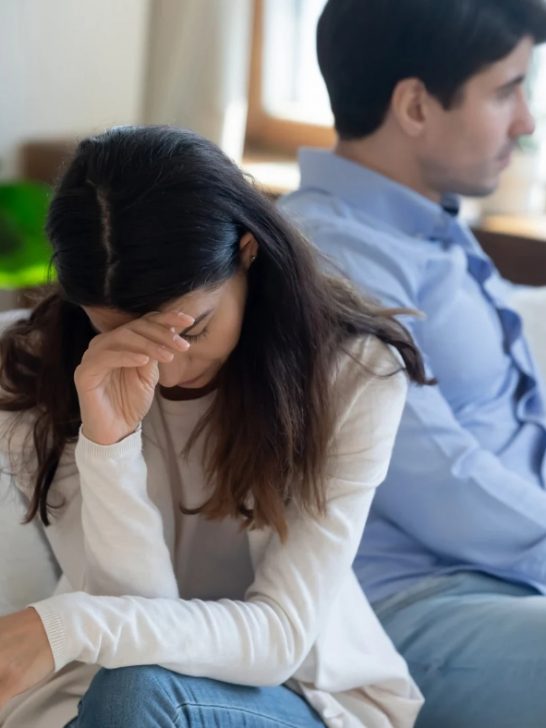
One of the worst things that can happen to a woman is to be blindsided by the end of her marriage.
To think everything is fine, and then one day your husband opens his mouth, and something comes out that you cannot unhear.
Something that lands in the middle of the life you thought you were building and changes the shape of everything.
Even though growing up, I heard stories of men who walked out on their families, most men who are done with their marriage don’t just leave.
But they tell you in words long before they go.
This post is about those words, and it’s not my intention to frighten you or send you replaying every difficult conversation your husband has ever had with you, looking for evidence of an ending.
No. I believe a woman who knows what she’s hearing can do something about it while there is still time.
Some of these sentences are the end, but some of them are a desperate male attempt to say something is very wrong, and they need help.
The only way to know which one you’re dealing with is to listen and take it seriously.
Whatever you do, don’t ignore it.
If Your Husband Says These 7 Things, Your Marriage Is Already Over
1. “I’m not happy, and I haven’t been for a long time.”

We know men don’t communicate enough.
Most men will swallow their feelings and keep showing up to a life that isn’t working for them without saying a word for years.
So in a strange way, a man who tells you he’s unhappy is doing something brave.
He’s communicating, and communication, even a painful one, is something you can work with.
But there are two very different sentences living inside this one.
“I’m not happy” is a cry for help. It’s a man saying something is wrong, and I need us to fix it.
Yes, it has urgency, but it also has hope because it assumes there is a we that can do something about it.
But “I haven’t been for a long time” is the part that should make you sit down because what this man is telling you is not that something recently went wrong.
He is telling you that he has been miserable for a while and has only now found the courage to say it out loud.
Which means by the time you’re hearing it, it has already been true for a long time.
That gap between when he started feeling it and when he finally said it is where marriages get lost because things that go unaddressed for a long time don’t stay the same size.
They grow and harden.
2. “I don’t know if I love you anymore.”
What do you mean you don’t know if you love her anymore?
I’ve been in this marriage business for a decade, and I know you won’t always be in love with your spouse.
That electric feeling that showed up in the beginning is not designed to stay at that intensity forever.
It settles and matures to something quieter but deeper and more sustainable.
But there is a difference between not being in love and not knowing if you love.
True love is a choice you make every day through different seasons.
A man who has been making that choice, even when things are not perfect, knows he loves his wife.
“I don’t know if I love you anymore” means the choosing has stopped.
Before you know it, it’ll become, “I know. And the answer is no, I don’t love you anymore.”
3. “I think we want different things.”
Yes, people evolve.
Nobody is the same person they were on their wedding day.
You grow, your priorities rearrange, and your understanding of yourself deepens.
That happens to both people in a marriage, and it is not automatically a problem, but this particular sentence is problematic because wanting different things is supposed to be a conversation, not a conclusion.
It is supposed to be “I’ve been feeling like we’re moving in different directions and I want us to talk about it.”
“I think we want different things,” said the way men say it when they mean something final is a closing statement.
It is a man who has already measured the distance between where he is going and where the marriage is going, and arrived at the conclusion that the two paths no longer meet.
And what makes it particularly hard to argue with is how reasonable it sounds.
Nobody did anything wrong. You just want different things.
It’s even almost polite, but polite doesn’t make it less devastating.
People evolve, but two people who are committed to each other evolve together, or at least toward each other.
When the evolution is happening in opposite directions, and only one of you has noticed, there’s fire on the mountain.
4. “I’m only staying for the children.”
God forbid I stay in a marriage solely because of my children.
If there weren’t children, what would happen?
A man who loves his children enough to stay in a marriage that isn’t working sounds like a good father, and maybe he is a good father. Those two things are not mutually exclusive.
But let me tell you three things this sentence does to a marriage:
First, it tells you exactly where you rank. Not as a wife or the woman he chose, but as a variable he has already subtracted from the equation.
The children are the reason. You are not.
Second, children are not saved by parents who stay out of obligation. They are shaped by the relationship they witness every day.
A loveless marriage teaches children what they should expect and accept in their own relationships one day.
Staying for the children when neither of the couple is in anymore is not protection. It is modeling. And what it models is not something any parent actually wants to pass on.
Finally, this sentence has an expiry date because the children will grow up and leave.
And when they do, the only thing left in that house will be two people who stayed for a reason that just walked out the door.
So if he is only staying for the children, the marriage needs help now, not when they leave.
5. “I don’t see the point in trying anymore.”
If you don’t want to try anymore, you don’t have a marriage.
You have a decision waiting to be announced.
Because marriage is two people who keep choosing to try, not without seasons where trying feels like the hardest thing in the world.
But you keep trying because what you built together is worth the effort.
The moment one person stops believing it’s worth the effort, the marriage is running on one engine, and one engine cannot carry two people indefinitely.
So, it’s not even “I don’t want to try right now” or “I’m exhausted, and I need a break.”
But I don’t see the point.
He has lost faith, not just in the marriage, but in the possibility of the marriage.
And faith, once gone from a marriage, is one of the hardest things to restore.
Not impossible, but hard, because you cannot argue someone back into believing or love someone into seeing a future they have already decided doesn’t exist.
6. “I don’t think counseling will fix this.”

Counseling is one of the last tools available to a marriage that is struggling.
Yes, it is not a magic wand, and it is not a guarantee, but it is something, and it is, in many cases, the last real chance.
So when a man says he doesn’t think counseling will fix this, he is saying that he has already decided nothing will fix this.
A man who wants to save his marriage will sit in an uncomfortable chair across from a stranger and talk about his feelings, because losing the marriage is worse than the discomfort.
A man who refuses counseling is a man who has lost faith in the marriage because a man who won’t try the last thing available has already made his decision.
He’s just waiting for the right moment to let you know.
7. “I love you, but I’m not in love with you.”
This is possibly the most devastating sentence in the English language when it comes from a husband because it sounds like he’s cushioning the blow and making sure you know you still matter.
“I love you” means he cares about you.
Your well-being matters to him; he doesn’t wish you harm, and of course, he has a history with you, so there’s a kind of attachment to you.
“But I’m not in love with you” means he has no romantic desire for you. The very thing that makes a marriage different from a very close friendship.
What you can do is ask when. When did it change?
Because sometimes “I’m not in love with you” is situational. Depression, burnout, stress, and unresolved hurts can temporarily extinguish the feeling without permanently destroying it.
But sometimes it is just true, and a woman deserves to know which one she’s dealing with, so she can decide, with full information, what she wants to do next.
I want to be careful here because this post could send a woman spiraling, so let me be clear.
One sentence, in isolation, on a bad day or in a hard season, does not mean your marriage is in trouble.
Men say things in frustration, so context matters and timing matters.
But if these words have been showing up in your marriage with a frequency and a weight that you’ve been trying not to think about, please don’t file this away and go back to normal.
The bravest thing you can do right now is have the most honest conversation of your marriage.
Not a fight or an interrogation. Ask him what he meant.
Ask him what he needs and if he still wants this, and then listen.
Your marriage cannot survive these sentences if you pretend you didn’t hear them.
Laura Bell
Monday 27th of April 2026
I feel as if my husband doesn't love or respect me anymore. I'm somewhat hard of hearing, not too bad, but he gets so angry when he has to repeat it again. I have hearing aids but they won't stay in my ears and I'm scared that they are going to fall out of my ears.
Also we argue a lot about money. We have separate accounts, always have had it that way, as he's very controlling .